

By Ben Boycott, CEO at DeGould
It’s hard to escape news about AI. From rapid technological advancements to concerns about its broader societal impact, cutting through the noise can be challenging, particularly for those operating in the fast-paced world of automotive manufacturing.
Yet within production environments, the role of AI is becoming clearer; not as a replacement for human expertise, but as a means of strengthening consistency, improving efficiency and supporting increasingly complex operations.
Nowhere is this more evident than at the end-of-line vehicle inspection stage, one of the most demanding phases in automotive manufacturing. Here, OEMs must ensure surface defects and specification issues are accurately identified and resolved across thousands of vehicles and several production shifts per day.
Many OEMs still rely on human inspectors to check each vehicle. While highly skilled, these teams are often working long shifts in environments that demand sustained concentration and precision.
Over time, fatigue and natural human variability can impact both speed and accuracy, particularly when inspections are repetitive and time sensitive. Human accuracy can get as low as 60 percent, particularly towards the end of a shift. This is not a reflection of capability, but of the challenge itself.
Despite the precision of current manufacturing methods, defects such as scratches, dents or inconsistencies in trim still occur. Identifying these issues before the vehicle leaves the assembly line is critical.
If missed, they can lead to significantly higher costs once vehicles reach dealerships or customers, where rectification is more challenging, costly and resource intensive.
At the same time, OEMs are operating under increasing pressure. Rising energy costs, ongoing supply chain disruption and broader geopolitical uncertainty are forcing manufacturers to re-evaluate how they maintain quality while controlling expenditure. What’s more, customer expectations are higher than ever. They want to receive perfect products free of defects.
This is where automated inspection technologies are beginning to play a transformative role.
Supporting consistency at scale
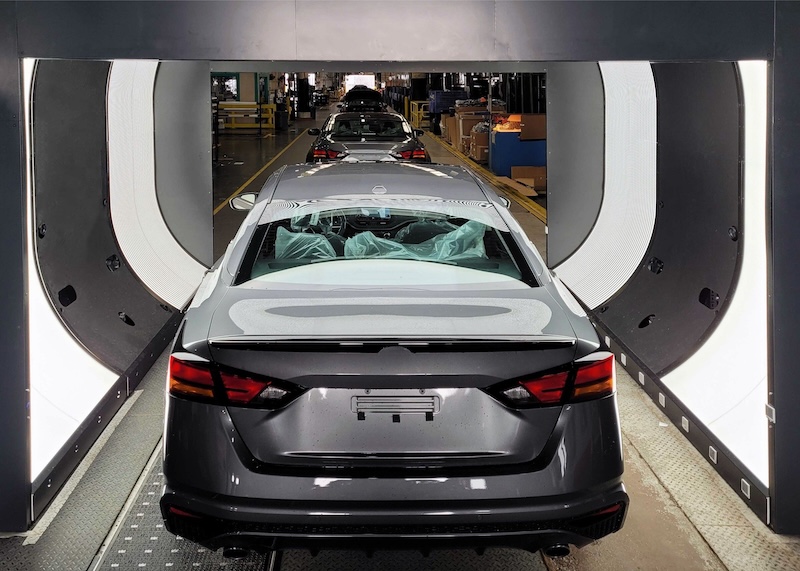
Automated visual inspection systems enable manufacturers to identify the exact nature and location of defects before vehicles leave the factory. By capturing and analysing large volumes of visual data, these systems can support more consistent detection while also helping teams identify recurring issues upstream in production.
This enables a powerful feedback loop, allowing OEMs to address root causes earlier, rather than managing costly fixes later.
Modern systems combine advanced imaging techniques with data-driven algorithms trained on extensive real-world datasets. The result is not just improved detection, but also more reliable decision-making, reducing false positives, improving specification checks, and enabling more proactive quality management.
Importantly, these technologies are most effective when deployed alongside skilled teams, enhancing their ability to maintain high standards across increasingly complex manufacturing environments.
Automated visual inspection systems like ours demonstrate how these solutions can be integrated into existing production lines, capturing detailed vehicle data at speed and scale while supporting operational efficiency.
A shift in quality control thinking
As manufacturing continues to evolve, so too must approaches to quality control. The question is no longer whether automation has a role to play, but how it can be implemented in a way that strengthens both performance and people.
OEMs that successfully combine human expertise with intelligent inspection systems will be better positioned to reduce costs, improve consistency, and respond more effectively to ongoing industry pressures.
In an environment where margins are tightening and expectations are rising, the ability to identify and resolve issues earlier is no longer a competitive advantage, it is becoming a necessity.

About the author: Ben Boycott is the CEO of DeGould. He is a business leader with experience in strategy development, global expansion, and company turnaround. He has led complex projects in China and international markets, with a background in low-carbon technology innovation and cross-cultural operations.


