

Astrolight contributes laser communication terminal technology to ESA’s HydRON Element 3 mission, led by prime contractor Kepler Communications
Kepler Communications, a Canadian satellite telecommunications provider operating the first commercial optical data relay constellation, is leading a group of industry partners, including Astrolight, a Lithuanian space and defense technology company developing laser communication solutions for space, ground, and maritime applications.
The companies have been awarded a multimillion-euro contract under the European Space Agency’s (ESA) High-throughput Optical Network (HydRON) to develop HydRON’s user-terminal segment, known as Element 3.
HydRON is a project under ESA’s Optical and Quantum Communications – Scylight programme, within the Agency’s Advanced Research in Telecommunications Systems (ARTES).
Led by Kepler as the spacecraft provider and mission operator, Astrolight will provide its latest-generation ATLAS-X laser communication terminal for hybrid optical links across LEO, GEO, and ground.
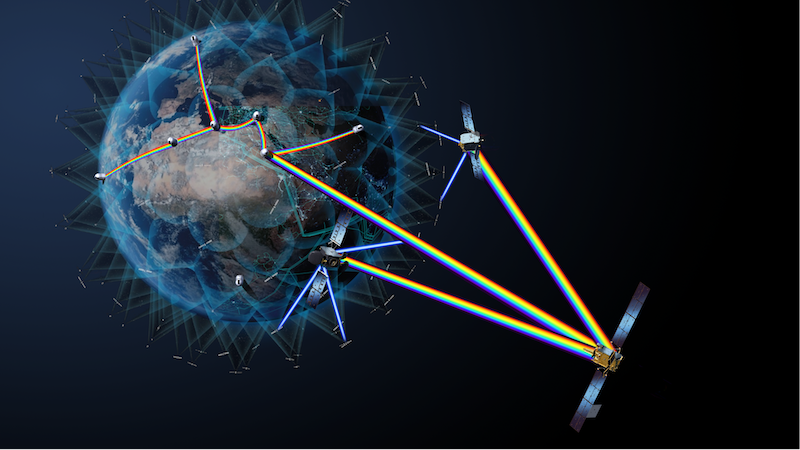
The HydRON project aims to demonstrate the world’s first optical multi-orbit transport network in space, extending high-capacity, fibre-like connectivity into orbit and bolstering the resilience of European communications infrastructure through a secure, high-capacity, and interoperable optical data relay network.
HydRON’s Element 3 mission focuses on demonstrating the applications of laser communication technology within the user segment by creating a testing environment in real operating conditions.
In the long term, it is intended to enable external commercial optical users to connect to the HydRON network and route their data through it.
As part of the mission, Astrolight’s ATLAS-X laser communication terminal will be hosted aboard a Kepler satellite for in-orbit demonstration. The mission will validate inter-satellite and space-to-ground links in LEO and attempt multi-orbit links between LEO and GEO.
Following the demonstration, ATLAS-X will serve as a data relay node, enabling the Kepler spacecraft to connect with other elements of the HydRON network.
Laurynas Mačiulis, CEO of Astrolight, says: “Working with Kepler on HydRON Element 3 gives us a valuable opportunity to validate ATLAS-X in orbit and bring customers closer to a terminal that supports high-capacity and secure data transmission through next-generation optical communication networks.
“As space becomes central to global infrastructure, supporting everything from telecommunications and national security to future in-orbit data centers, the need for optical connectivity will continue to grow.”
Laurent Jaffart, director of resilience, navigation and connectivity, says: “HydRON will serve as the world’s first multi-orbital optical communications network with a terabit per second capacity, offering resilient and efficient data transfer to address the challenges of bringing connectivity to multiple users securely, quickly, and reliably.
“Today’s signature with Kepler Communications continues our collaboration on the project, as they contribute their expertise in concert with their consortium to deliver Element 3; the component of HydRON that’s key to building new industrial capabilities, demonstrating new service concepts, fostering system extensions, and promoting international cooperation and interoperability.”
ATLAS-X is Astrolight’s next-generation low-SWaP (size, weight, and power) laser communication terminal, building on the company’s earlier ATLAS-1 and ATLAS-2 solutions.
It is designed for both space-to-space and space-to-ground links and features a coarse pointing assembly, offering greater operational flexibility and easier deployment across a wider range of spacecraft.
ATLAS-X is compatible with a subset of the ESA Specification for Terabit/sec Optical Links (ESTOL) standard and is SDA-compatible.
Mina Mitry, CEO and co-founder at Kepler, says: “As Kepler works with ESA to advance next-generation optical communications infrastructure in space, interoperable and low-SWaP terminals such as ATLAS-X will play a key role in opening these networks to a broader range of users.”


